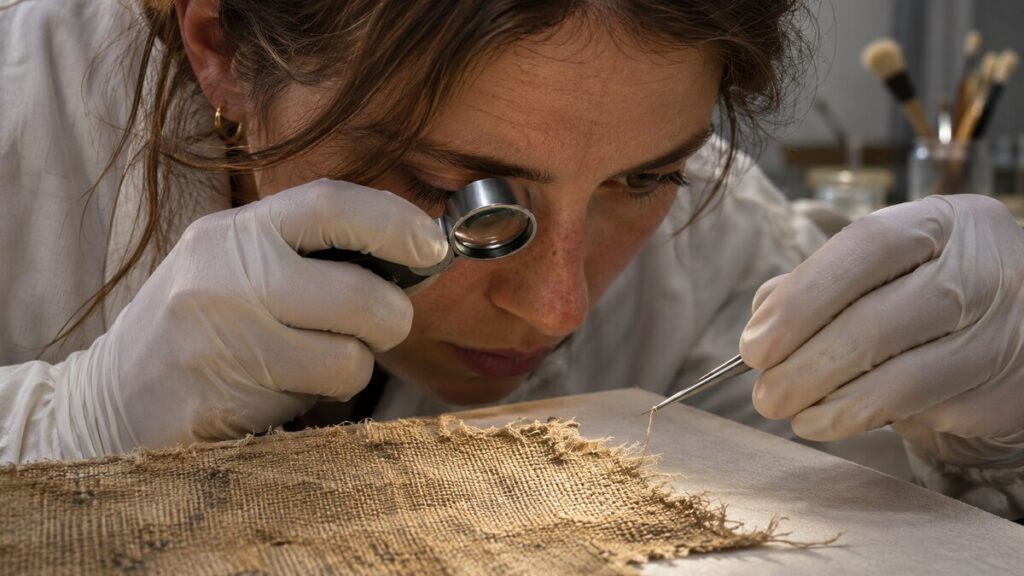
Anyone standing in front of the Överhogdal hangings in Sweden has plenty to look at before considering the thread. Figures cross the woven surfaces, animals follow one another and the eye starts making stories of their journeys. A botanist looking at the same objects might begin with a humbler mystery. What plant supplied the pale fibers that helped hold the pictures together?
When an old description becomes an assumption
The local account of the hangings’ discovery places them in a storehouse near Överhogdal church in 1910. By the time scientists revisited the fibers, earlier descriptions had identified the plant material as flax. A reader encountering that identification in several accounts could easily assume several examinations had confirmed it. The investigators found little documentation of the methods behind the attribution. Returning to the material offered a way to test it.
Both flax and hemp supply bast fibers, obtained from the stem. Once the surrounding plant tissue has been removed, a spinner is left with long, strong fibers shorn of many of the features a botanist usually relies on. There is no flower, leaf or seed left in an old thread to settle its identity. Color can change with age and treatment. The thickness of a piece of yarn also depends on the spinner, who decides how much material to bring together.
The twist inside the wall
A single fiber cell has a feature that can survive processing. Within layers of its wall, bundles of cellulose wind around its long axis. The dominant direction of that winding can help distinguish plant groups. It belongs to the cell wall itself. The twist that someone later gave a whole length of yarn is a different feature, on a scale large enough to see with far less magnification.
A microscopy method developed for textile bast fibers uses polarized light to examine that internal orientation. Under suitable conditions an individual fiber changes its optical appearance in a characteristic way when turned. Interpreting the observation requires a known comparison and care in selecting the fiber. Where plants share characteristics, further evidence may be needed. Work on identifying historical hop fibers shows why analysts also consider plants outside the familiar pair of flax and hemp. A persuasive identification comes from explaining what observation distinguishes the plausible alternatives in this particular sample.
Two pieces yield a different answer
Researchers examined ten Scandinavian textile samples, including material from all five pieces of the Överhogdal hangings. Their study in Scientific Reports found hemp in four of the ten samples. In the two hanging pieces designated Ia and Ib they identified both hemp and flax. In the samples from the other Överhogdal pieces they found flax. The result changed the description of particular threads and complicated a tidy distinction between fine flax textiles and coarse hemp work.
A mixed result needs especially precise wording. Finding two plant species in one object leaves open several possibilities about how a weaver organized them. A small sample from one thread cannot show their proportions throughout an entire hanging. The study of blended historical hemp textiles makes the broader question worth asking wherever collections contain plant-based yarn. A conservator has to weigh what a second sample could answer against what taking it would cost the object.
What remains the weaver’s secret
A microscope can revise a museum description. It cannot say whether the two plants were chosen for their handling qualities, their availability or a detail of workshop practice now lost. Nor do four positive samples estimate the share of medieval Scandinavian cloth made with hemp. The surviving textiles are a small and extraordinary selection, quite unlike a random bundle from a medieval household.
Return to the hanging and the figures still travel across the same ground. What changes is the imagined work behind them. A modern viewer may see a single pale length of cloth. A spinner working centuries earlier handled fibers from plants that a later catalog placed under one familiar name. In this instance the evidence for that difference survived almost invisibly, wound into the walls of the cells themselves.