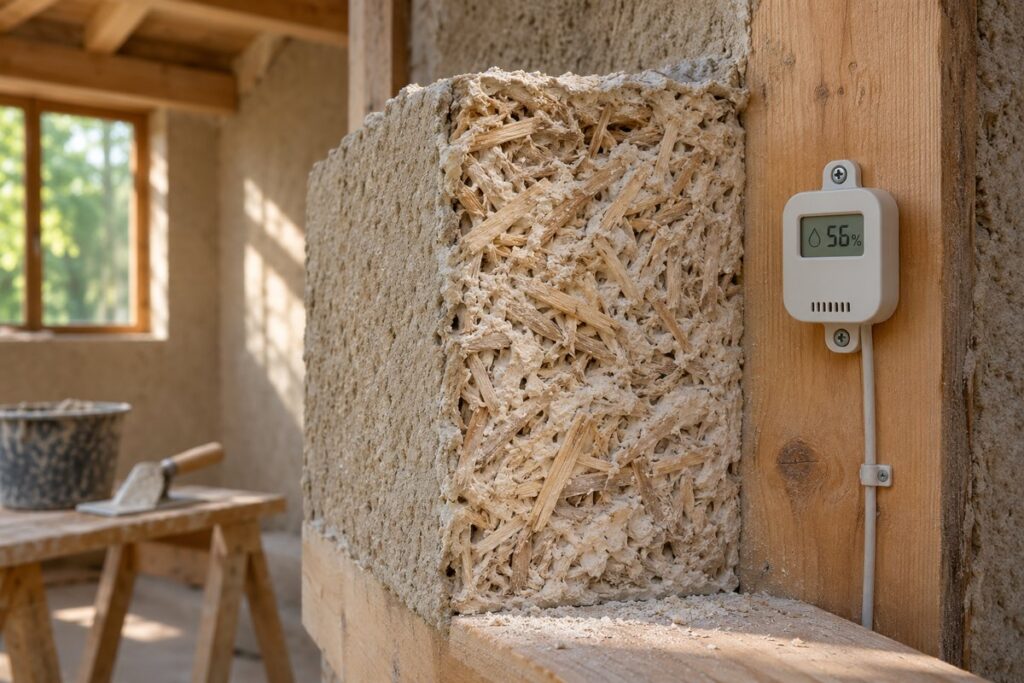
Fresh plaster and dry paint can look much the same from across a room. To water vapor, their surfaces may be very different. Behind either finish, a hemp-lime wall contains pieces of the woody core of hemp stalks embedded in a mineral binder. Some of that material can take up water from humid air and give it back later. How much of it gets a chance to do so during a shower or an evening’s cooking depends partly on what the water encounters first.
Researchers can watch the exchange without ever seeing a droplet. They place a wall specimen in air of known humidity, weigh it, change the humidity and weigh it again. A sample that gains mass during the damp interval and loses it during the dry one has kept a small, temporary store of water.
One day in a humidity chamber
A common Nordtest procedure for moisture buffering uses a repeating cycle. At controlled temperature, the specimen spends eight hours at 75 percent relative humidity and sixteen at 33 percent. Relative humidity describes how close air is to saturation at that temperature. By controlling both temperature and humidity, the experimenters can give different wall samples comparable conditions day after day.
The area exposed to the air matters. Comparing the raw weight gain of a large panel and a small one would tell us partly which panel was bigger. The moisture buffer value expresses the mass exchanged in relation to the exposed area and the change in relative humidity. It lets an investigator ask how two finishes perform when given the same square meter of wall and the same swing in humidity.
Moisture does not have unlimited time to move inward. The part of a thick wall that takes part in a short daily cycle can be much shallower than its full thickness. A slow seasonal change poses a different problem from a few hours of humid air. Laboratory measurements of hemp-lime concretes help distinguish the material’s capacity to hold moisture from the rate at which moisture moves through it.
Then the researchers painted the surface
In a comparison of hemp-lime wall assemblies, investigators tested exposed hemp-lime alongside samples with different internal linings and finishes. Both exposed hemp-lime and hemp-lime under lime plaster earned the protocol’s “excellent” moisture buffer rating. Applying a particular trade paint to the lime-plastered assembly moved it into the “good” category. On other assemblies, the researchers measured reductions of roughly 61 to 69 percent in the buffer value with that paint.
Those percentages belong to the finishes and assemblies tested. A clay-based paint in the experiment gave better buffering than the trade paint. Describing any painted surface as sealed, or any unpainted one as fully open, loses the most interesting part of the result. The finish itself can take up water, and it can affect how quickly vapor reaches the layers beneath it. The balance between those effects depends on the combination.
A kitchen is a different experiment
In an occupied room, the wall shares the work with ventilation, furnishings and other surfaces. Open a window and the water can leave with the air. Turn off the heat and the relative humidity can change even if no new water enters. A panel’s laboratory ranking cannot by itself predict the relative humidity beside a real kitchen stove at six in the evening.
There is also a difference between vapor entering a surface from the room and liquid water arriving through a leak. A daily buffering test gives a panel a drier interval in which to release what it took up. Persistent wetting can remove that opportunity. A result obtained by cycling damp and dry air gives no measure of how well a wall assembly will handle a plumbing failure.
The useful detail in a specification, then, is the sequence of materials a person can touch and those hidden underneath. A coat of paint weighs little beside a wall. For the modest amount of water on the move before the kettle has cooled, its position at the very front can matter a great deal.