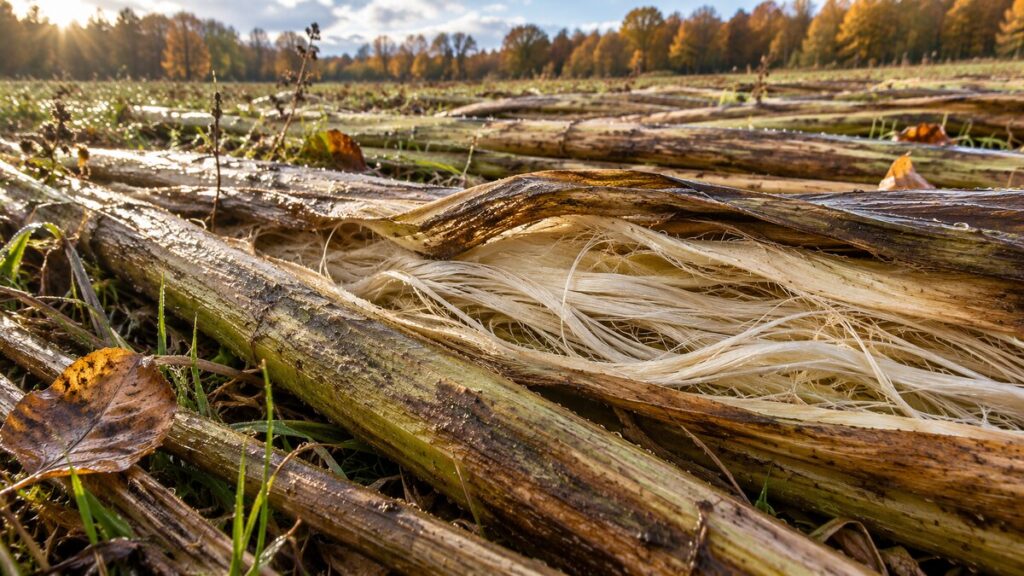
A hemp stem already contains the long fibers a textile maker wants. Their original job was to help a living plant stand upright, so they come firmly attached to other tissues and to one another. Pull a fresh stem apart and the plant’s success becomes the spinner’s difficulty. Centuries before anyone could name the organisms involved, people took advantage of a biological way to loosen those attachments. They let the cut stems ret.
A useful place for decay to begin
Near the outside of the stem, elongated bast fibers lie in bundles. Their walls are rich in cellulose. Around and between them are materials including pectins that help hold plant cells together. A textile maker wants enough separation for the fibrous material to be extracted and processed while retaining useful length and strength. What the microbes consume, and where they consume it, matters more than how quickly the whole stem disappears.
In field retting, cut stems lie outdoors and become the habitat of bacteria and fungi. Moisture and temperature vary over the field and through time. Microorganisms produce enzymes that can break down components of the stem. A review of microbial communities in hemp field retting describes the changing community alongside the changes in plant tissue. It is tempting to look for a single organism responsible for making good fiber. A community has an additional complication: one organism can gain access to a surface or a nutrient because another reached it first.
Who is there and who is working?
A DNA survey can reveal that material from a microbial group is present on a stalk. It cannot, on its own, establish that the group supplied the enzyme responsible for a particular cut in the plant tissue. Conversely, an assay showing pectin-degrading activity tells an investigator something happened without automatically identifying every organism involved. Microscopic images can locate damage while leaving its maker uncertain.
Researchers can put these records in sequence. If a group becomes abundant, a relevant activity rises and the structures that activity could affect subsequently change, a plausible explanation emerges. The case is stronger if it recurs in independent samples. A study connecting field biodiversity to retting functions asks which microbial observations might consistently indicate changes in the material. Even then, the weather may be influencing the organisms and the plant at the same time. Research on water retting combines observations of enzymes and microbial populations in a different setting. Permanently submerged stems present quite different living conditions from stalks exposed to dew and drying air.
The day count hides the weather
Suppose two fields spend the same number of days after cutting outdoors. In one, the stems experience regular moisture. In the other, several hot, dry days interrupt microbial activity. Counting days treats these histories as identical. An investigation of moisture during hemp field retting addresses precisely why conditions during exposure deserve attention. Even within a stalk, the surface facing the soil can experience a different environment from the side facing the sky.
The properties of the material at harvest also matter. A study comparing hemp harvested at different growth stages followed changes during field retting and found that the consequences of prolonged exposure depended on the material researchers started with. Separation can become easier while other properties become less desirable. A rise in the measured proportion of cellulose may simply mean some noncellulosic material has disappeared. It does not mean the cut stem has begun manufacturing fresh cellulose.
From a loosened stem to a thread
The word quality changes meaning as a sample moves through a workshop. Easy release from woody material is one virtue. A fine, long bundle that can withstand later handling is another. Measuring only how readily a stalk comes apart would miss the point at which more extensive breakdown weakens the fiber a spinner hopes to use.
Retting is therefore an unusually intimate collaboration between decomposition and craft. The microbes encounter food and changing weather. The textile maker sees a material that, for a time, has become easier to separate without losing what made it worth separating. The thread exists because those two histories briefly coincide.